
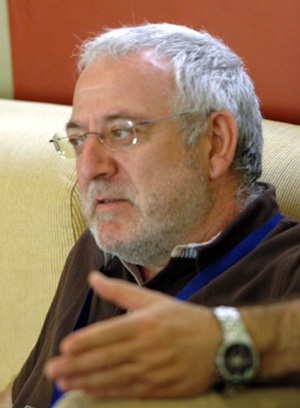
Maestro de Enseñanza Primaria – Licenciado en Educación Física – Licenciado en Geografía e Historia – Doctor en Historia Contemporánea. Catedrático de Universidad. Líneas de Investigación: Didáctica de la Educación Física. Historia, Política y Filosofía del Deporte. Fundador de La European Union Physical Education Associations (EUPEA) Comité de Expertos del Consejo de Europa. Coordinador del Foro Hispanomexicano de la Educación Física y el Deporte
SPORT IN SCHOOL-AGE. A CONFLICT OF INTEREST BETWEEN THE EDUCATION SYSTEM POLICY AND SPORTS
Prof. Dr. Manuel Vizuete Carrizosa
Extremadura University – Spain
mvizuete@unex.es / mvizuete59@gmail.com
1 Introduction.
The different processes of reform of education systems in Europe often touch only tangentially the issue of sport at school age. The lack of tradition in the educational system with respect to physical education as a subject fully integrated into education systems and the lack of appreciation of their curricula and educational content as well as the fact that sport in school has been located , from its origins in a kind of nebula or no man’s land in which the education and culture concepts are confused usually, which has given more importance to the forms than to the bottom, along with the not inconsiderable political and media pressure on educational concepts relating to sport in school, have led both the sport and the sport-school curriculum, an educational immunodeficiency situation, which places the faculty and the education system with almost no ability to react, to pressing issues with nature of pandemics, are affecting not only the educational treatment of sports, intra-and extra-curricular, but also the social body, which alarms relating to health in terms of morbid obesity of children, violence in sport, doping of athletes schoolchildren and other types of abuse in sport as a framework, urging a full investigation and urgent action.
True, and in this case contrasted, than necessary educational reforms often lack influence in the life of the classroom, especially if no special attention to training and professional development of teachers, since this is the key factor that determines the success or failure of the implementation of any reform or curriculum innovation. In this case, and despite being a group particularly young and anxious about his training, both the inertia and the huge deficits as a theoretical foundation within their initial training, unable to change the preconceptions they bring and justify the choice of profession, Fullan (1991)[1] validate the theory when he argues that:
Changes in education depend on what the teachers think and do something so simple and yet so complex…
Despite having made a huge effort, probably one of the biggest and best in the neighboring countries, in curriculum design in the planning approach and teaching in physical education at all levels, is no less true that these efforts and the consequent structural and curricular changes proposed from the government are not sufficient to cause a significant change in the teaching approaches of teachers, leading to real clarification of objectives and content and, consequently, to improve education, simply because teachers are not just limited to technical reforms or implement curricular innovations. The teachers have knowledge, ideas, values, attitudes and ways of understanding their discipline that are motivating its decision-making, which must be added, his own life experience, the personal and social and professional contexts in working, which are especially critical to the implementation of any proposed curriculum implementation.
We are facing a new position and social requirement responds to recent demand, emergent and urgent, seeking in physical education and the practice of sport and physical activity an effective defense against threats to health and quality of life, resulting from the new social dynamics and changes in lifestyles. Those circumstances having been raised in a geometric progression in the last quarter of the twentieth century, pandemics threaten to become, if not social cancers, economically costly, difficult to treat and great alarm.
The disappearance of the cold war and the new social dynamics imposed by this circumstance to sports policies, severely marked traditional perspectives and approaches existing physical education and school sport until then oriented towards a sports physical concept to be restated, in the light of these new demands and social perspectives, towards a new concept emerging in Europe, related to the health and quality of life, defined as culture of the movement. In this regard have been key studies and investigations made by Bart Crum (2004), Brettschneider and Kleine (2003), Hardman and Marshall (2000), Vizuete (2002) Carreiro da Costa (2005) subject to rigorous debate within the scientific community and backed by European investigations and meetings.
This is of the necessary conceptual clarification, whether the sport in school or sports activities offered to our school curriculum both in the physical education course as the social practices of sport in school, promoted by the administrations, qualify and educational teaching, both quantitative and qualitative, targeted and justified, to this new social orientation of physical activity, defined as health practice is a hallmark of growing, the same way, which have established to be institutional and educational measures to ensure the educational dimension.
The problem lies in not having been able, so far, to understand from education budgets, the striking changes in mentality and social dynamics, related to sport and culture of the movement, which have taken place in recent years, and should have been assumed by the school concept of discipline, redefining the curricular and extracurricular sports, physical education guidance to this new form of culture.
From a strictly scientific and educational, in the light of scientific contributions in the area of knowledge and contemporary science education, we must ask:
- We now hold that the mere practice of a sport, without there being any process of teaching and curriculum planning in itself is educational?
- From a scientific point of view and educational, you can continue to accept and maintain that a child or a child in school, do a sport with the same rules, same disciplinary rigor and the same intent as an adult?
- You can accept that an activity with great educational potential, such as sport, can be manipulated, more to miseducate which to form democratic citizens and socially integrated, due to which interest is not known and that it may also be made from pure voluntarism and teaching without training?
In contemporary education, physical education for the XXI century, to which we refer, aims to educate in sports rather than education through sport. The reasons are simple and coincide with the above. Education through sport requires, in principle, in practice ignore the value and impact of the uncertainty factor on the outcome of the alleged action sports and education, which is what makes an attractive activity. Scientifically speaking, you cannot raise educational activity assuming, a priori, a high degree of uncertainty about the results, while, to educate in sport, education involves the acceptance of uncertainty factors and recognizing its educational value as a driver of practice of physical activities and sports throughout life.
In the usual practice of physical activities, the company is ahead of policy approaches and educational inertia showing every day, every time we go out into the street, in sports news or on television, what are the contemporary requirements of knowledge physical activity, and which is therefore the treatment of sport education required by the twenty-first century society.
This is how the sport at school age has to be rethought and oriented towards the participation and integration of future citizens in the culture of the movement. This approach requires less curricular school sport sportsman and closer to the humanistic, individual reality of each school, their physical capabilities and their integration into this new way of understanding physical activity.
It must be possible to sport at school age to suit each and every need, which would lead, in practice, the application of the concept individualized instruction in physical education and sport, without this may be antithetical to the values of solidarity, cooperation and teamwork, traditionally attributed to the sport, as part of their own educational rhetoric. This concept leads us to the school sports curriculum with formal and informal means of quality requirement, qualified technicians, open and non-traumatic, which is really important social integration and maintenance of health through the practice of physical activities.
These are the motivations that lead us to rethink the concept of sport at school age, research and the first prospective study and then the sport in the school they founded, technically and socially, the educational practices of children’s sports content and young twenty-first century. Some backgrounds of these concerns are part of the line of work developed in recent years in many European countries. As reference works, may be the studies of De Knopp (1996)[2] in a research in 11 European Countries pointing out the vulnerabilities and structural weaknesses of European sports and educational systems to solve the problems raised by the team-sports youth.
From theses recent studies conclusions, we can determine the existence of a crossroads situation in Europe regarding youth sport in the sense that exhausted traditional sports promotion based on talent identification or increased competitive practice from early ages, as ideal formula to increase the number of elite athletes, there is a situation of social reaction in the youth and intellectual world, against the social and institutional structures in the last quarter century, have been giving shelter to sport Youth from the quarry on this understanding of elite sport, or as a way to justify social policies relating to culture and the welfare society. In our view, the leaders of these crisis situations would be:
- The sports policy of the last thirty years in which bet heavily on a fall in the age of initiation into competitive sport.
- The identification of talents and expanding technology, compared to the monitoring of the educational theories and pedagogical qualification for professional practice of physical education and school sport and youth.
In the first case the drop of sport are caused by exhaustion of the capacity for satisfaction of personal needs from the sport by establishing a common denominator for all, with the consequent consideration like things of athletes, and an assessment of individuals base its competitiveness and its sporting success and, second, by the existence of a dehumanizing practice of selective physical activities, so that detected the talent, the almost-no-talent or talents, to add to the ranks of absolute anonymity without the sports system, again have the slightest interest in them. In both cases, the dropout are more than justified and demonstrates the inability of the sport to have a complete picture of the social landscape from an educational perspective.
2 Conceptualization and meaning of sport at school age Methodology and Research Development.
From this level of concern was raised, by the Sports Council of Spain and the Barcelona Olympic Foundation, the need for a clear view of the role of sport in school ages, as well as knowledge of the positions that both the intellectual elite and public administrations at different levels, supported the concept sport at school age, and which should be educational policies, and training of specialists and technicians, as well as the function represented by the government with responsibility for these federal policies and structures of sport.
First designed and validated a questionnaire (Annex 1) aimed at university professors in the specialty of physical education and sports science dimensions of the problem posing and asking clear proposals for the conceptualization and approach to political education and sport at the age school.
Same questionnaire was sent to local governments, sports authorities of the State government and sports federations with interest or tradition in organizing sports activities for schoolchildren. In all cases we chose people who had had personal contact or experience in any level of education, preparation and organization of sport in school.
After two days’ work in a multidisciplinary group and an excellent work for discussion and reflection by the experts participating in a previous consultation who attended the meeting sponsored by the Higher Sports Council, the Generalitat de Catalunya and the Barcelona Olympic Foundation, it was a series of concussions; the listed the most important and significant.
- Means for sport at school age that develops with children at these ages and therefore may have different levels of organization and guidance, but always respecting their rights and developmental characteristics that are established as lower and as an athlete in school. Differentiating the school sports curriculum integrated into the physical education curriculum own educational goals, school-age sport, as a projection of the practice-oriented learning stable physical activity.
- From the clarity of this approach is necessary to establish a route of administration and powers that will allow both processes are possible and complementary.
- This discussion should generate the necessary and fundamental arguments that define the areas of institutional competence on sport at school age, from the considerations mentioned in the above headings.
- We understand that the concept of sport in school should be placed in the context closest to the student’s life, and that its two fundamental references should be the school and the family home, so that the powers should be, both in educational administration and in the next sports administration.
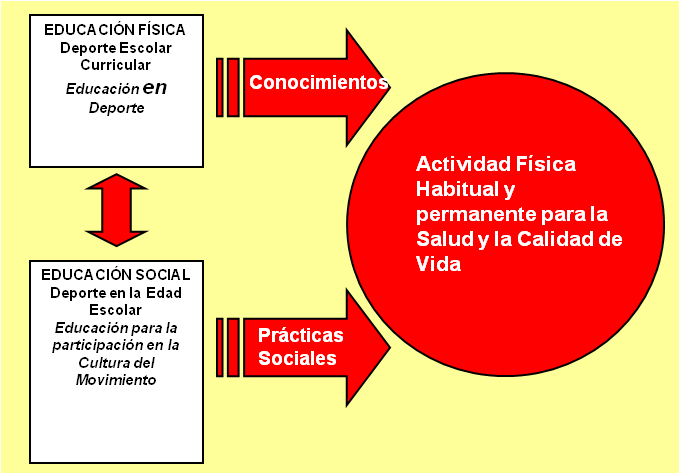
M. Vizuete. Location curriculum, extracurricular sports. Study for the White Paper on Sport in the 2006 School-Age
There is unanimity in considering the educational dimension of sport in school age and the need for its close relationship with the school based management in this sense should distinguish between:
- Curricular school sport. As an essential part of the curriculum of physical education course, aimed at acquiring knowledge, skills and abilities related to different sports and ultimate purpose of which corresponds to the health and social dimension of the practice of physical activities as usual activity the rest of life.
- Sport at school age. Understood as a practical application of knowledge acquired in the subject of physical education, aimed at social and civic participation in the culture of movement from outside the school, involving all social partners and governments, maintaining the educational dimension and taught by experts with the required quality controls in a democratic society and technologically advanced.
- High competition sport with school ages athletes. Understood as practiced by the school or school-age persons belonging to the elite sports. He was out of the debate by having their own identity and not be applicable to the objective of the discussion group, however, raised the need to work in a Child Protection Policy which give equal protection Athlete both these athletes as any other aimed at both the punishment and prevention of any circumstances, criminal conduct, or abuse that may occur to the school both in sport immediately, and to the physical or psychological consequences as a result of sports could occurring.
- The sportivization of the physical education is presented as the result of external pressures that have participated equally in the schools, teachers, school athletes and parents, having been in too many cases, undermined the purpose of sport in the curriculum and external practice.
- National guidelines on sport at school age. They appear as absolutely necessary and urgent, and must be addressed in a legal document to establish and clarify the powers of the state both as models of participation and competence of the Autonomous Communities related to/or:
- Equality of opportunity for all children to sport at school age, regardless of the territory in which they are.
- From the understanding of the educational value of sport in school and their membership unequivocally the concept of integral education of the person, must be treated like any other field of education, guaranteeing a minimum educational content for all Citizens, especially geared to the health and quality of life.
- Development of the freedom of movement, choice and participation in sport at school age, regardless of the territory in which they are.
- Enjoy the rights established for the practice and / or competitive sport, regardless of the territory in which they are or where they reside.
- It therefore poses the need for a pact of state for sport at school age that should be translated into a National Plan of sport at school age.
- Although popular culture is one of the benchmarks of educational action, however, in practice, it should be noted certain positive and negative factors that could undermine or qualify the educational outcomes of sport at school age:
- Excessive media influence or introducing negative factors in the ways of understanding the sport.
- The early specialization and the pursuit of early results.
- The value and impact of social integration that the practices of sport at school age have as a positive.
- Development of democratic values and participation in social development of the sport.
- Participation in sport federations at school age, is complex and not without debate, it seems clear that the vast majority of actors involved, do not bet on the sports federations involved in the sport at age school, and in any case, if necessary, it seems clear that their participation should be subject to a number of controls and constraints of powers to ensure the educational function that is pursued and that, by its nature, departs from the purposes of competition, selection and elitism of the world federation for themselves what is involved:
- Establish general guidelines that clearly define the functions and objectives of the sports federations in sport at school age, and the powers of the institutions involved.
- Establish clear separation between the sport in school and sports Land, ensuring the identity of both approaches to sports, without possibility of errors or confusion.
- In terms of sports policies in the last 30 years. Persistent errors are recognized, of which are the following:
- Existence of standard low-current and without connection to reality and the interests of children and young people today.
- Persistence of models competitiveness which anchored in the period of the Cold War and in school sports schemes as grassroots sport.
- No attention to diversity and customization of training and education in sport.
- Sports selective versus inclusive sport and neglect poorly equipped.
- Lack of training and specific technical update for the sport at school age with rigor and scientific approaches.
- Institutional policies silos with little or no permeability, without optimization of resources or support for school athletes.
- Lack of an educational approach rigorous scientific approach.
- Permanent divorce between the curricular school sport and sport at school age.
- The need to develop a curricular approach for school age sports on scientific and rationally built on real budgets.
- Increase investment in research and technical training in sport at school age.
Conclusions and proposals for the development of school sport at school age.
From the results, the scientific bibliographic and consulted, and in light of our own study we believe that following the methodology marked by the Council of Europe, the sport at school age in Europe, should ensure its efficiency and quality in accordance the following criteria and actions:
- Understand that the schedules of sport in school must assess the materiality both physical and psycho-evolutionary of children and adolescents, avoiding the overlapping patterns of adult sport.
- Develop models of democracy programs in which young people themselves can have a voice and participate in making decisions. In this sense, it recommends the development of protocols and manuals of good practice to guide the various actors of sport at school age.
- Establishment of minimum requirements that give a common structure for sport in school, and that contains these features:
- Participatory.
- Adapted. Creation of different types of rules.
- Co-educational and inclusive. Enhancement of association.
- Additional physical education.
- Coordinated (government agents).
- Education in the competition.
- Safe and healthy, and health enhancer and values.
Policies to develop both the State and the Communities should be framed according to these premises, with the current social structure and taking into account all the actors involved:
Necessity of an International Body for the prevention of risks, and abuses, on sport and the athletes of school age.
The reality of the contemporary world and uniformly accelerated social changes that characterize the society of communication and new technology of the twenty-first century requires an ongoing effort to upgrade and enhancement of the reality of sport in school and sport for young, so it is seen as absolutely essential to the creation of an international conference of sport at school age permanently to guide the development of sport for children and youth in two ways:
- As the guarantor of cultural identity and education, taking the lead and responsibility in each case may be.
- As a vigilant and responsible for establishing early warning signals to react in time on the aggressions from the world of entertainment, fashion or jeopardize the health of children and youth.
The public authorities shall maintain and ensure the operation of this conference regulations establishing its endowment, its functions, composition and functioning, should be represented all those involved in sport at school age.
Rules for the Protection of the highly competitive athlete in school ages.
Access to high competition and professionalism of the athletes is produced in ever younger ages and within the school, so that specific legislation, it is necessary to ensure:
- The constitutional rights of compulsory education and quality assurance.
- The ban on training sessions that exceed the limit on average working hours or the time corresponding to the age of the athlete.
- The availability of leisure time and guarantees of social relationship with people his age concentration outside the sport.
- The maintenance of family ties as much as possible avoiding the uprooting.
- Establishment of measures to overcome the post-competitive phase, avoiding the psychological damage or feelings of frustration when leaving the competition.
- Creation of guarantee funds to ensure financial and professional future after leaving the competition or the end of the sporting life, avoiding the economic vacuum and the social uprooting.
Extremadura University – Spain
References.
CAVILL, N, BIDDLE S.: (2001) what are the determinants of young people’s participation in physical activity? Does activity in childhood continue into adulthood? Paper for NHF Young@Heart conference .National heart Forum, London, 2001.
DE KNOP, P.: European trends in Youth Sport: A report from 11 European countries. European Journal of Physical Education, Manchester, 1996, 1, pp.36-45
DURNIN, JVGA. (1992) Physical activity levels past and present. En: Morgan N, editor. Physical activity and health. Cambridge: Cambridge University Press, 1992:20-27.
ENGSTROM, L-M.: (1991) Exercise adherence in sport for all from youth to adulthood. En: Oja P, Telama R, editors. Sport for all. Amsterdam: Elsevier, 1991:473-483.
FULLAN, M. (1991). The new meaning of educational change. Chicago: Teacher College Press, p. 117
GORDON-LARSEN, P, McMURRAY, R, y POPKIN, B.: (2000) Determinants of adolescent physical activity and inactivity patterns. Pediatrics, 2000; 105:6.
HARDMAN, K, MARSHALL, J.: (2000) The state and status of physical education in schools in international context. European Physical Education Review 2000, 6, 3: 203-229.
MALINA, RM.: (1996) Tracking of physical activity and physical fitness across the lifespan. En Research Quarterly for Exercise and Sport 1996; 67(3, Suppl.):S48-S57.
POWELL, KE, DSYINGER W. (1987) Childhood participation in organized school sports and physical education as precursors of adult physical activity. En American Journal of Preventive Medicine 1987; 3(5):276-281.
RIMPELA. M, TELAMA, R.: (2001) Trends in physical activity – and inactivity – in early adolescence: experiences from Finland. Heart Matters. 1; 2001; 3-6
SHIELDS, D.L.L. y BREDEMEIER, B.J.L..: (1994) Bredemeier. Character development and physical activity. Champaign: Human Kinetics. 1994.
TELAMA, R., LAAKSO L., YANG X., VJIKARI, J.: (1997) Physical activity in childhood and adolescence as predictors of physical activity in young adulthood. Am J of Prev Med 1997;13(4):317-23
TWISK, JWR. (2001) Physical activity guidelines for children and adolescents: A critical review. Sports Medicine 2001: 31 (8); 617-627
VIZUETE, M.: (2007) Libro Blanco del Deporte en la Edad Escolar en España. Madrid. Consejo Superior de Deportes.
WADDINGTON, I., MALCOM, D. & GREEN, K: Sport, Health and Physical Education: Reconsideration. European Physical Education Review, Vol 3,nº 2, Manchester,1997,pp165-182.
[1] FULLAN, M. (1991). The new meaning of educational change. Chicago: Teacher College Press, p. 117
[2] DE KNOP, P.: European trends in Youth Sport: A report from 11 European countries. European Journal of Physical Education, Manchester,1996, 1, pp.36-45
 efidex
Buenas tardes, saludos Dr. Manuel Vizuete Carrizosa, desde Tehuacán Puebla, México, un pequeño lugar del estado de Puebla, que usted, conoce, tengo el gusto de conocerle, a través de Juan N. Gerones Toríz (QDEP), sigo de manera continua su blog, el cual comparto, con los colegas, que siguen la resistencia a la lectura, por tanto su ámbito donde opinar se reduce, a sus actividades diarias, actualmente estoy jubilado, debido a no alcanzar este ideal, que para Transformar, como señala la última reforma de Educación en México; debemos iniciar de manera personal, esto no sucede, el cambio, no aparece, solo recibir la información y acomodar lo que siempre se hace, para lo que pida el gobierno… así que esta dolencia sobre el Deporte Escolar en México, sigue en deterioro, cada vez más acentuada, NO logramos entender: Deporte competitivo de rendimiento con el Deporte escolar… las autoridades, lo siguen estimulando, solo como parte del discurso de las autoridades, de todo tipo…. ya dijo ahora debemos hacerlo.
tenemos grandes desafíos sociales, ahora de inseguridad, alimentación, transporte, entre otras más… que se pasan a segundo termino, y siguen engañando en dar la clase de educación física, sin sentido formal… ?¿Qué se desea hacer y para Qué?… por tanto digerir y asimilar esta lectura excelente, no se logra acomodar, pues se espera que se comparta… solo actividades, desde una visión del juego libre sin sentido, y deporte que no tiene intervención docente, solo se reduce a invitar a quienes desean participar en los deportes que oferta el gobierno, en una convocatoria.. agradezco su atención… seguiré compartiendo en documento y de palabra, que para cambiar, debemos empezar por nosotros.
ABEL SALVADOR CID LÓPEZ – Tehuacán, Puebla.. México 2381093265, correo jomache407@gmail.com
Buenas tardes, saludos Dr. Manuel Vizuete Carrizosa, desde Tehuacán Puebla, México, un pequeño lugar del estado de Puebla, que usted, conoce, tengo el gusto de conocerle, a través de Juan N. Gerones Toríz (QDEP), sigo de manera continua su blog, el cual comparto, con los colegas, que siguen la resistencia a la lectura, por tanto su ámbito donde opinar se reduce, a sus actividades diarias, actualmente estoy jubilado, debido a no alcanzar este ideal, que para Transformar, como señala la última reforma de Educación en México; debemos iniciar de manera personal, esto no sucede, el cambio, no aparece, solo recibir la información y acomodar lo que siempre se hace, para lo que pida el gobierno… así que esta dolencia sobre el Deporte Escolar en México, sigue en deterioro, cada vez más acentuada, NO logramos entender: Deporte competitivo de rendimiento con el Deporte escolar… las autoridades, lo siguen estimulando, solo como parte del discurso de las autoridades, de todo tipo…. ya dijo ahora debemos hacerlo.
tenemos grandes desafíos sociales, ahora de inseguridad, alimentación, transporte, entre otras más… que se pasan a segundo termino, y siguen engañando en dar la clase de educación física, sin sentido formal… ?¿Qué se desea hacer y para Qué?… por tanto digerir y asimilar esta lectura excelente, no se logra acomodar, pues se espera que se comparta… solo actividades, desde una visión del juego libre sin sentido, y deporte que no tiene intervención docente, solo se reduce a invitar a quienes desean participar en los deportes que oferta el gobierno, en una convocatoria.. agradezco su atención… seguiré compartiendo en documento y de palabra, que para cambiar, debemos empezar por nosotros.
ABEL SALVADOR CID LÓPEZ – Tehuacán, Puebla.. México 2381093265, correo jomache407@gmail.com